English for Juniors (E4J)

English for Juniors (E4J)


أنا والإنجليزي

Objectives

  • Communicate effectively in everyday English situations. / التواصل بفعالية باستخدام اللغة الإنجليزية
  • Understand and use practical vocabulary and idiomatic expressions. / فهم واستخدام مفردات عملية وتعابير شائعة
  • Gain confidence in speaking / بناء وتعزيز الثقة في التحدث باللغة الإنجليزية
  • Improve listening comprehension / تحسين مهارات الاستماع والفهم السمعي
  • Utilize school content to use for speaking practice / توظيف محتوى المنهاج المدرسي في أنشطة تدريبية تساعد على المحادثة

Topics

Prerequisites

Mandatory Assessment, follow the link and submit the Assessment Form.

للالتحاق بالبرنامج، يرجى الدخول إلى الرابط المرفق وتعبئة نموذج التسجيل.

Meet the Trainer

Diala Taneeb is a native English speaker with extensive experience in writing, storytelling, and performance. After earning a master’s degree in advertising from Boston University, she works as a creative copywriter, helping businesses across various sectors use engaging and expressive language to connect with diverse audiences. Diala is eager to help young Palestinian students do the same, so they feel confident using English beyond the classroom.

For more information

To learn more fill the following form (English or Arabic) and a training consultant will call you:

← Back

Thank you for your response. ✨

Business English (BE)

Business English (BE)

Objectives

By the end of this course participant will:

  • Develop language building techniques
  • Engage in business conversations comfortably
  • Deliver professional presentations
  • Communicate with peers, suppliers, and upper management in English.
  • Express verbally or in writing about daily business situations.

Language Building Blocks

  • Professional structure of written correspondence
  • Review past emails written by participant
  • Discuss some key points
  • Receive and give feedback on grammar and phrasing of emails
  • Guided exercises to collect information
  • Use within context
  • Online follow-up
  • Tips on using PowerPoint
  • Building presentation content
  • Actual delivery of information
  • Receiving questions
  • Tips on professional communication
  • Simulations of situations to practice communication and negotiation techniques.
  •  
  • Participants receive a weekly reading plan that includes articles or videos to collect information and reuse phrases.

Training Topics

  • List of verb tenses,
  • List of parts of speech
  • List of linking words
  • List of grammatical rules

Lorem ipsum dolor sit amet, consectetur adipiscing elit. Ut elit tellus, luctus nec ullamcorper mattis, pulvinar dapibus leo.

  • How to write a business pitch
  • Organizing thoughts
  • Goal setting
  • Business negotiations
  • Business acronyms
  • Improve your presentation skills
  • Personal branding
  • Banking terminology
  • Banking article
  • Practice expressing current affairs in English
  • Reading material
  • Reference material
  • Links to videos
  • Additional material related to participants field of work

Prerequisites

A placement test.

To learn more fill the following form (English or Arabic) and a training consultant will call you:

← Back

Thank you for your response. ✨

Translation and Language Services

Translation and Language Services

If you are seeking training in Business English Language, click here.
.إذا كنت تبحث عن تدريب في اللغة الإنجليزية للأعمال، انقر هنا

Our team is at the ready to provide tailored, world-class language solutions to serve all your professional language service needs.

Languages

Arabic
العربية
English
English
Hebrew
עִברִית
French
français
German
Deutsch
Spanish
Español

Any other languages may be considered by request and on a case-by-case basis.

Services

At the hands of our team, translation is more of inter-lingual discourse analysis. Your words, their shadows, and senses are safely shipped from one cultural, functional, linguistic shore to another. We promise your document won’t smell translated.

We will be your tongue while delivering your precise message to your target audience. Let us handle the how of the linguistic aspect and your event (i.e., conference, meeting, field visit, etc.) will flawlessly flow.

We take pride in the quality of our interpretation services, which are brought to you at the hands of top-caliber interpreters with relevant sector experience.

Be it a consecutive or simultaneous mission, we are confident that our interpreters will help your event, or even a doctor’s appointment, meet its ends.

Services types:

  • Simultaneous Interpretation:
    Real-time translation where the interpreter renders the speaker’s message into the target language while the speaker continues to speak. Typically used in conferences and large events with specialized equipment like headphones and microphones.
  • Consecutive Interpretation:
    The interpreter speaks after the speaker has finished a segment of speech. Notes are taken during the speech, and the interpreter delivers the message after the speaker pauses. Commonly used in meetings and interviews.
  • Whispering Interpretation:
    A form of simultaneous interpretation where the interpreter whispers the translation directly into the listener’s ear. This method is used when only a few individuals require interpretation, such as in small meetings.
  • Remote/Virtual Interpretation:
    Interpretation provided remotely over the internet using video or audio technology. This allows participants in different locations to receive interpretation without being physically present in the same location.

With Ritaj, your audio and visual materials will be accessible by your target audience in their mother tongue language.

Our subtitle translators are fully aware of how to strike the balance between the picture that speaks volumes, the sound, and the linguistic message in pursuit of enjoyable, accurate audiovisual material.

Service types:

  • Standard Subtitles:
    Traditional subtitles that primarily convey dialogue and relevant sounds for viewers who can hear but may not understand the language spoken.
  • Closed Captions (CC):
    Subtitles that include not only dialogue but also non-verbal information like sound effects and speaker identification. They are designed for viewers who are deaf or hard of hearing.
  • Forced Narratives:
    Text that appears on screen in addition to dialogue, often used to translate written text or signs within the scene. This is typically used to ensure clarity for all viewers, regardless of language or hearing ability.

At Ritaj, we cater our content writing solutions to outstrip your expectations. We will help you flesh out your ideas in the best way possible in writing.

With nearly two decades of experience, we are the best suited to make the best out of your unedited documents. Shoot them our way, and we will have them ready for publication in record time.

We tailor our editing services to meet your requirements.

Errata, typos, common mistakes are part of the course of writing. Put your feet up and relax as we ensure your document is linguistically error-free.

Our Translators...

Ritaj constantly thrives to incorporate experienced, industry-specific translators among the team.

Educated in Palestine and abroad, the team has developed solid translation skills as well as cultural awareness to ensure that messages are received as intended.

Our diverse team members are currently residing in the United States, Canada, and across the Middle East, as well as Palestine. This ensures continuous language and cultural development, as well as being exposed to up-to-date changes in a multitude of industries.

Our Interpreters...

Ritaj’s interpreting team has a proven track record in delivering professional interpreting services with experience among team members ranging between 9-19 years.

All team members follow a standard preparation process for any interpreting event to ensure quality and the highest accuracy in conveying the message.

Our Team Leader...

Ms. Nisreen Musleh has over 19 years of experience in the field of language services particularly translation, interpreting, and editing.

In 2007, she has established and now is the Team Leader of Ritaj’s Language Service Department. Her core value is to maintain top-quality deliverables on every assignment. Her role involves strategic planning, capacity building, and driving opportunities for language services in both local and international markets.

She has also implemented the triangle approach for each project–to have a team of translators, editors, and proofreaders for each translation project–that proved its efficiency via customer satisfaction surveys.
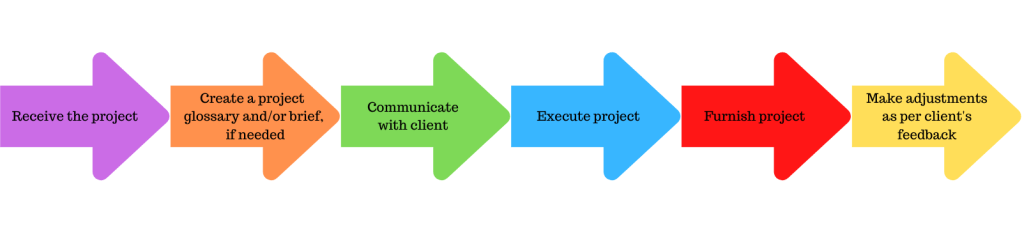
Our translation methodology

Ritaj’s team seamlessly manages translation assignments based on the following methodology.

  1. Build a glossary to unify terminology among the translators working on the project
  2. Ensure that all graphs, footnotes, or any other parts of the document are open source and can be reproduced in the target document
  3. Submit a sample part of the document for technical approval by client
  1. Clarify any needed terminology, check for reference material 
  2. Agree on the suitability of the set deadline and target document review process
  3. Assign someone from the client’s staff to proofread the document
  1. The team leader assigns the translation projects and oversees the translation process
  2. Translators edit the translated target documents
  3. Team leader proofreads and confirms compliance with assignment’s glossary
  1. Client receives the documents in target language for review and feedback, if any
  2. Team leader follows up with client in case any further edits are needed.
  1. Make adjustments as per client’s feedback

Sample of our clients

Let us contact you

Our Language Services Department Coordinator is standing by to discuss how Ritaj may serve your needs.

Kindly fill the following form (English or Arabic) and we will call you:

← Back

Thank you for your response. ✨

Data-driven Decision Making (DDDM)

Data-driven Decision Making (DDDM)

Objectives

Gain a clear understanding of the following topics:

  • Data Collection
  • Data Integrity
  • Master Data Control
  • Storytelling with Data
  • Monitoring and Interpreting Results

Learn the skills to:

  • Properly collect data
  • Properly control data
  • Ask the right questions
  • Paint the story
  • Present the story
  • Track the results

Topics

  • Session 1: Overview of Excel functions with focus on pivot tables
  • Session 2: What is Data-Driven Decision Making? (Overview)
  • Session 2: What is “Proper” Data and Where Do We Get It? (Data Collection & Integrity)
  • Session 3: How Do We Manage All of This? (Master Data Control)
  • Session 4: How Do You Tell a Story with Data? (Analytics & Presentation)
  • Session 5: Decision Made, Now What? (Tracking Results)


Minimum 2 years of work experience in people management; AND/OR in analysis (or equivalent) role.


To learn more fill the following form (English or Arabic) and a training consultant will call you:

← Back

Thank you for your response. ✨

English for Beginners (EFB)

English for Beginners (EFB)

EFB Course:

Topics

  • General review of grammar and sentence structure
    • Five major grammatical rules
    • Sentence formation
    • Question formation
    • Prepositions
  • Introduction and greetings
    • Habits, routines and interests
    • Speaking in occasions
    • Compliments
  • Jobs, careers
    • Application forms
    • Job titles and task description (org. structure)
    • Interviews, at the office, office equipment
  • Telephone speaking techniques
    • Common phrases on the phone
    • Handling business calls, personal calls
  • Giving directions
    • Phrases and prepositions to give directions
    • Learn about names of places
    • Give directions to actual places in Ramallah e.g. their work, home, draw maps
  • Traveling and business trips
    • Related terminology
    • Airports, car rentals, hotels
    • Short dialogues at such situations
  • Political words (News headlines today in Palestine)
    • Present vocabulary used to talk about the general situations in Ramallah
    • Preparation from English newspapers for group discussions in class
  • Health issues
    • Minor health problems vocabulary
    • At a clinic, talking with a doctor
    • Medical /dental care role play
  • Money and banking
    • Related terminology
    • At the bank
  • Making suggestions and recommendations
    • Structure
    • Common expressions
  • Evaluation
    • Oral and written exam

Prerequisites

A placement test.

To learn more fill the following form (English or Arabic) and a training consultant will call you:

← Back

Thank you for your response. ✨

English Language Program (ELP)

English Language Program

ELP Courses:​

Participants can sign up to any of the listed courses based on a placement test:

1.      Tips to Improve Your Language Through Reading & Listening – One day course

2.      English for Beginners – Beginners

3.      English Conversational Skills – Upper beginners

4.      Business English – Intermediate level

5.      Business English – Upper intermediate level

6.      Business English – Advanced level

 Sector-specific ELP courses:

7.      English for Banking Communication – Intermediate to advanced

8.      English for NGO Professionals – Intermediate to advanced

9.      English for Business Meetings – Intermediate to advanced

10.  English for Diplomats – Intermediate to advanced

11.  English for Law – Intermediate to advanced

12.  English for Media Professionals – Intermediate to advanced

13.  English for Executives – Intermediate to advanced

14.  ELP – Coaching – All levels

Prerequisites

Each course requires a placement test.

To learn more fill the following form (English or Arabic) and a training consultant will call you:

← Back

Thank you for your response. ✨

Professional Translation Certification – PTC

Professional Translation Certification (PTC)

Objectives:

Upon completion, the trainee will be better able to:

1. Identify research resources
2. Utilize technology tools to generate translated text
3. Translate more accurately and less literally
4. Critically proofread a translated text
5. Analytically defend one’s own translation
6. Translate from and into legalese

Topics:

  • Introduction of trainers and guest speakers
  • Methodology
  • Outline
  • House rules
  • Kick-off assignment
  • Research resources for translators
  • Online search techniques for translators
  • Hands-on dictionary use techniques for translators
  • Expert advice
  • Common paralinguistic mistakes
  • 10 MS suite tips for translators
  • Writing skills: simplicity, clarity and elegance
  • Common errors and pet peeves
  • Approaching a text
  • Translation techniques
  • Translation strategies
  • Target text proofreading
  • Pre-submission checklist
  • Terminology building techniques
  • Media translation
  • Political translation
  • Business translation
  • Literary translation
  • Introduction
  • Legalese
  • Legal Drafting
  • Legal jargon
  • How to become a MoJ certified translator
  • What to brand?
  • Where to brand?
  • How to locate and land jobs on local, regional and international markets
  • 3-hour final assessment test

Frequently Asked Questions (FAQ)

PTC is tailor-made to meet the needs of the labor market in the field of translation, it serves both experienced and inexperienced translators to elevate the translation skills. Accordingly, the prime focus of PTC is on professionalism. Safe to say that PTC is not a level-based but a competency-based training, it starts with boosting your research and analytical reading skills, utilizing your technological devices, building your terminology, and reaches to approaching translation as a process, the types of translation and the techniques of avoiding literal translation. PTC provides you with the appropriate reading plan that goes hand in hand with the topics discussed throughout the training course to foster your knowledge.

Bearing in mind that the translator usually gets in touch with a variety of documents, especially in case he/she works at the Palestinian labor market; the chances of getting a job opportunity as a specialized translator in one only field is little to none compared with the capacity of the market. Therefore, PTC gives the prime focus on the process, approaches, and stages of translation among a variety of topics. To list some: we focus on legal, commercial and social translation, so the first stage before getting to be specialized, and in introducing you to the steps upon which the translator gets to improve his/her skills in the desired topic.

Yes! The certificate is approved by the Ministry of Education and Higher Education. The goal of this training is to enable you to enter the labor market, and to that end, we at Ritaj offer our trainees two job opportunities if proved to have excellent performance throughout the training course.

Yes! PTC has a specified section that handles preparing and studying for the Palestinian Ministry of Justice Translation Certification Examination.

Yes, you are examined twice, once prior to the course, and once after.

No, you can only take the course by attending the sessions at Ritaj’s premises.

Yes, it is a requirement to have a BA degree in language, education, or in another related field.

Yes! The first job opportunity you will be met with is at Ritaj in the Department of Languages and Translation.

The trainers are professional and experienced translators and practitioners.

The minimum requirements needed to succeed in this training:

English proficiency
80%
Very good command of Arabic and English
85%
Strong professional development motivation
80%
Basic computer and MS skills
80%
Self-Commitment
90%
To learn more fill the following form (English or Arabic) and a training consultant will call you:

← Back

Thank you for your response. ✨