Resource Mobilization (RM)

Resource Mobilization for the Resilience of Civil Society Organizations (RM)

حشد الموارد لدعم صمود مؤسسات المجتمع المدني

Objectives:

Training approach and methodology will focus on exploring and learning how to make more informed strategic decisions, to pivot resource mobilization/fundraising efforts based on financing prospects in the prevailing situation, and on simple but impactful adjustments to render CSOs more financially resilient.

  • Learn about institutional financial resilience
  • Know how to make organization more attractive to givers of all kinds
  • Strengthen traditional and non-traditional resource mobilization skills

Topics:

  • Personal introductions and motivations
  • What each person has to give to the group
  • Organizational presentations
  • What each organization has to give to the other organizations
  • Participants’ expectations
  • How do we explain our success in resource mobilization?
  • How do we explain our failure in resource mobilization?
  • Lessons learned: How did we get to where we are now?
  • How do we envision resource mobilization prospects in the current and near future situation?
  • Money right now: financial fire-fighting?
  • Financial risk mitigation?
  • Financial resilience?
  • Financial sustainability?
  • Is resilience always good?
  • Resilience versus Transformative-Resilience
  • Determinants of financial transformative-resilience
  • Decolonization of Aid and transformative financial resilience
  • Community-led Development and financial transformative resilience
  • Financial resources
  • Funding streams
  • Non-financial resources
  • Governance and accountability mechanisms
  • Resource mobilization policy
  • Clear organizational strategy and plans
  • Medium Term Resource Framework
  • Adaptive management capacity
  • Credibility
  • CSO resource mobilization challenges/issues
  •     CSO Revenue sources
  •     Financial vulnerability: revenue concentration; independency ratio; dependency quotient
  •     Which (available and potential) resource(s) that CSO could mobilize in the current situation? How?
  • Resource mobilization objectives and targets
  • Resource mobilization options:
  •       Financial
  •       Non-financial
  • Resource mobilization tools

Donor cultivation and retention

  • Identifying funding need
  • Concept Note
  • Donner mapping and identifying potential donor(s)
  • Funding Proposal
  • Follow-up with funding agencies

Prerequisites

Relevant work experience

Trainer

Mr. Khail Nijem is a strategic/spatial planning, project management, and community development specialist with a regional planning and civil engineering background. He has consolidated over 35 years of experience (more than half of which in senior level positions) in public, private, and NGOs sectors as an academic, researcher, and practitioner working in spatial and strategic planning, project planning and management, and institutional building. He has extensive experience in development planning at the national, regional and local levels and in relating community development issues to the public sectors’ and NGO’s planning and development functions. He led and/or participated in drawing several national, sectoral, regional, local, and institutional strategic plans as well as, in formulating a number of policy documents and tools. In Addition, Mr. Nijem has acquired considerable experience in managing large/complex development, capacity building, and institutional building projects both in Palestine and in the Middle East Region. He also provided consultancy and training services to public institutions, as well as, to local and international NGOs in the areas of strategic planning, policy development, participatory management, program/project planning, resource mobilization and fundraising, monitoring and evaluation, institutional building & organizational development, and participatory community research methods. Mr. Nijem is also NGOs activist serving as a Board member of several NGOs.

Testimonials

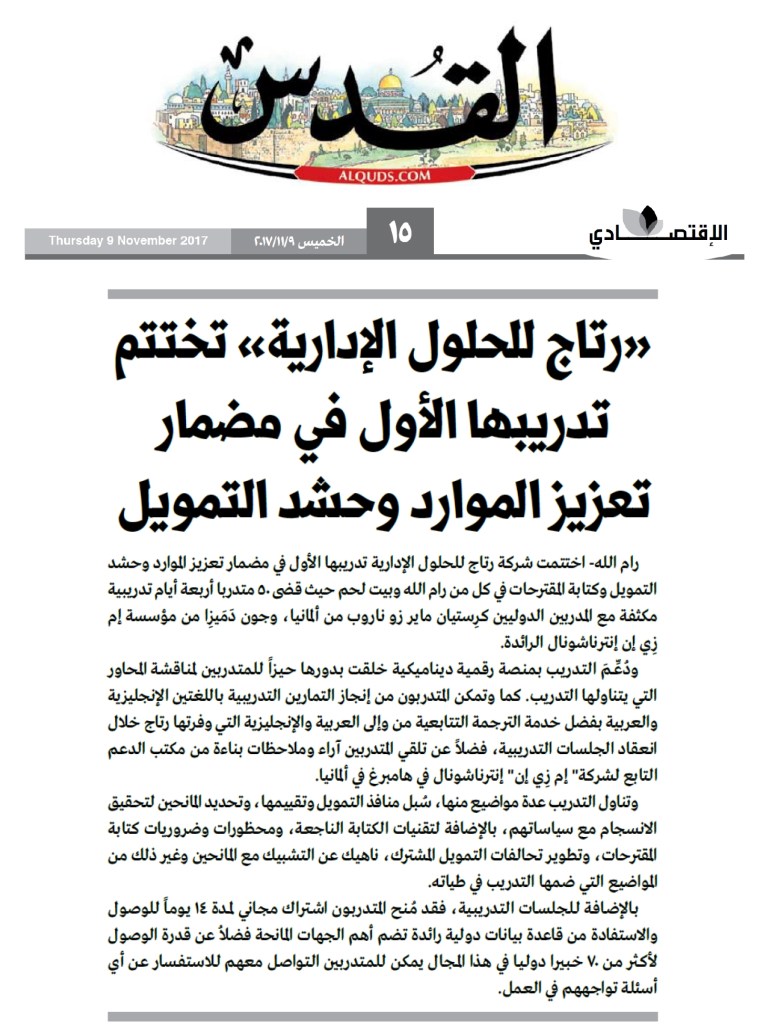
Past Media Coverge

To learn more, fill the following form (English or Arabic) and a training consultant will call you:

← Back

Thank you for your response. ✨

Project Proposal Writing (PPW)

Project Proposal Writing (PPW)

كتابة مقترحات المشاريع

Objectives:

Upon completing this course, trainees will have a foundational understanding of the topics below, as well as an ability to utilize and implement the concepts learned which include:

  • Participants will be able to identify and describe the key funding structures, processes, and priorities.
  • Participants will be able to explain the essential components of a successful project proposal, including problem statements, objectives, methodologies, and budgets.
  • Participants will apply learned concepts and skills to real-world scenarios through drafting sections of a project proposal in sectors of their organizational interests.
  • Participants will develop the ability to incorporate innovation and sustainability into their project proposals while effectively communicating their ideas.

Topics:

  • Horizon Europe, Erasmus+, and other relevant programs.
  • Differences between grants, tenders, and contracts.
  • Overview of project proposal components.
  • Alignment with donor priorities and policy objectives.
  • Innovative approaches and added value.
  • Sustainability and impact assessment.
  • Project Proposal Writing Process and Guidelines.
  • Project proposal objectives and expected outcomes.
  • Project proposal narratives and justifications.
  • Project activities and timeframe.
  • Project budget and financial plan.
  • Review and Submission Process.

Prerequisites

  • Project management skills and familiarity with project planning, implementation, and evaluation
  • Writing and communication skills, proficiency in English (as all proposals are submitted in English).
  • Budgeting and financial management, understanding of financial planning, cost estimation, and budget development.
  • Ability to work collaboratively in interdisciplinary teams.
To learn more, fill the following form (English or Arabic) and a training consultant will call you:

← Back

Thank you for your response. ✨